








Traveling to a new country is an exhilarating experience. You have your passport, your bags are packed, and your itinerary is ready. But in our modern world, one question has become critical: “How will I get the internet?”
Staying connected is no longer a luxury; it’s a necessity. We use our phones for digital maps, ride-sharing apps, instant translations, checking hotel reservations, and sharing moments with family back home. For decades, the default solution was international roaming. You’d land, your phone would connect to a local network, and you’d have service. It was simple, but it often came with a shocking price tag.
Now, a new technology, the eSIM, is challenging this old model. In this guide, we’ll explore the debate of international roaming vs eSIM, breaking down the costs, convenience, and technology to help you make the smartest choice for your next journey.

What is Roaming? Understanding the Traditional Method
So, what is roaming? In simple terms, international roaming is a service provided by your home mobile carrier that allows your phone to use the network of a foreign carrier. When you travel outside your home country’s coverage area, your phone “roams” onto a partner network.
This is possible because your home provider has a business agreement with that foreign provider. You keep your same phone number, you can make and receive calls, and you can use data just as you would at home. The convenience is undeniable. There’s no setup, no new SIM card to buy. It just works.
However, this convenience is built on a complex and expensive system of inter-carrier agreements. That foreign network charges your home carrier a high rate for letting you use its towers, and your home carrier passes that cost—plus a significant markup—directly on to you. This leads us to the biggest drawback of this system: the fees.
Understanding International Roaming Fees
The most significant barrier for travelers has always been the notoriously high international roaming fees. Anyone who traveled in the early 2000s or 2010s likely has a “bill shock” story—returning from a one-week vacation to find a phone bill for hundreds, or even thousands, of dollars.
While some regulations (like the European Union’s “Roam Like at Home”) have solved this problem within specific regions, travel outside these zones is a different story.
Carriers typically charge for international roaming in a few ways:
- Pay-Per-Use: This is the most dangerous model. You are charged for each megabyte (MB) of data you use, each text you send, and each minute you talk. Data rates can be as high as $10-$20 per MB. To put that in perspective, simply loading a few web pages or checking Instagram could cost you $50.
- International Day Passes: To make costs more predictable, many carriers now offer flat-rate daily passes. These might cost $10 to $15 per day to use your domestic plan’s data allowance. This is much safer, but it adds up quickly. A two-week trip would cost an extra $140-$210 on top of your regular phone bill.
- Specialized Travel Plans: Some carriers offer monthly add-ons for international travel. These provide a small, fixed amount of data (e.g., 2GB) for a set price. This is better, but the data is often limited and slow.
Because of these high costs, one of the first things many travelers do upon landing is to dive into their phone’s settings.
How to Turn Off Roaming (and Avoid Accidental Charges)
Knowing how to turn off roaming is arguably the most important setting to learn before you travel. Failing to do so can mean your phone starts using expensive data in the background without you even realizing it.
Here is how to do it on the two most common platforms:
On an iPhone:
- Go to Settings.
- Tap on Cellular (or Mobile Data).
- Tap on Cellular Data Options.
- You will see a toggle for Data Roaming. Make sure this is in the OFF position.
On an Android Device (steps may vary slightly):
- Go to Settings.
- Tap on Network & Internet (or Connections).
- Tap on Mobile Network (or SIMs).
- You will see a toggle for Roaming. Make sure this is disabled.
By turning this setting off, you prevent your phone from using any mobile data. You can still safely use Wi-Fi at your hotel or in cafes without incurring any international roaming fees.
What is an eSIM?
The challenges of international roaming created a gap in the market, one that eSIM technology has filled perfectly.
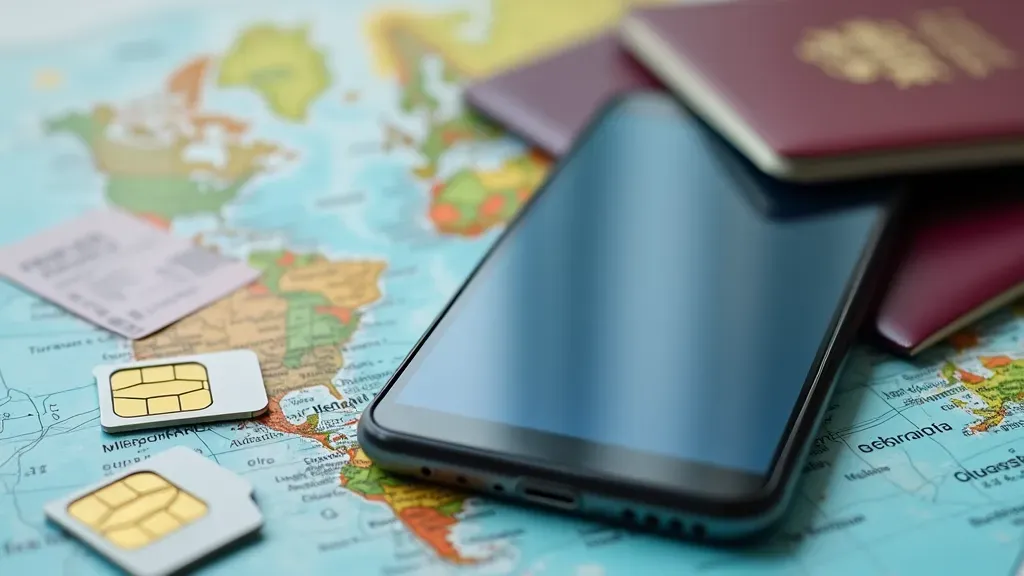
An eSIM, or “embedded SIM,” is a small, digital chip built directly into your phone by the manufacturer. It’s not a physical card you swap. Instead, it’s a rewritable chip that lets you download and activate a cellular plan digitally.
Here are the main advantages:
- No Physical Card: You don’t need to find a store, use a paperclip to open your SIM tray, or worry about losing your tiny home SIM card.
- Instant Activation: You can buy a data plan online from an eSIM provider, like KiNSim, receive a QR code via email, and be online in minutes.
- Multiple Profiles: Most phones allow you to store multiple eSIM profiles at once. This means you can have a plan for Japan, another for Italy, and another for the USA, all stored on your phone.
- Local Rates: This is the biggest benefit. eSIMs connect you directly to a local network, allowing you to pay local, prepaid rates for data. This is almost always significantly cheaper than international roaming.
International Roaming vs eSIM
The international roaming vs eSIM debate comes down to a few key factors. Let’s compare them side-by-side.
1. Cost and Transparency
- International Roaming: Costs are often high and can be unpredictable. Daily passes are expensive ($10-$15/day), and pay-per-use rates are dangerous. The pricing is set by your home carrier.
- eSIM: Costs are transparent, prepaid, and low. You buy a specific amount of data for a fixed price. For example, a provider like KiNSim might offer an unlimited data plan for Thailand for a set number of days, costing a fraction of what a single daily roaming pass would. There are no surprise fees or bill shock.
2. Flexibility and Control
- International Roaming: You have zero flexibility. You are locked into whatever plan and partner networks your home carrier offers.
- eSIM: You have total control. You can shop around from dozens of global and local eSIM providers to find the best price and data package for your specific destination. If your data runs out, you can easily top up or buy a new plan online.
3. Convenience and Setup
- International Roaming: This is the one area where roaming wins on (initial) convenience. It works automatically as soon as you land, and you keep your primary phone number for calls and texts (though calls will be very expensive).
- eSIM: Requires a simple, one-time setup (scanning a QR code) which takes about two minutes. You will typically get a data-only plan. This is a major benefit, as it allows you to keep your primary WhatsApp number active. You can use an eSIM from a service like KiNSim for all your cheap data, while still receiving calls and texts (like 2FA codes) on your home number.
4. Connection Quality
- International Roaming: Your connection quality depends entirely on your carrier’s agreement. Sometimes, you may be deprioritized or “throttled” to slower speeds on the partner network.
- eSIM: You are essentially a customer of the local network. eSIM providers, such as KiNSim, often partner with the best and fastest local networks in each country, ensuring you get optimal 4G or 5G performance.
Which One Should You Choose?
The choice between an eSIM and international roaming depends on your travel style.
Choose International Roaming if: You are on a short (1-2 day) business trip, your company is paying the bill, or you are traveling within an area with a “Roam Like at Home” agreement (like the EU).
Choose an eSIM if: You are a tourist, a backpacker, a digital nomad, or anyone who wants to use data freely without fearing a high bill. If your trip is longer than two days, especially to popular regions in Southeast Asia like Vietnam, Thailand, or Malaysia, an eSIM is almost certainly the cheaper, better, and more flexible option. Services like KiNSim offer affordable, unlimited data plans that activate instantly and save you from the high costs of international roaming.
Frequently Asked Questions (FAQs)